
AI startup ditches Anthropic for DeepSeek and “saves millions”
Plus: LibreOffice takes aim at Euro-Office — and more.

Hi folks,
This week’s lead story looks at how soaring AI inference costs are forcing some companies into decisions they probably wouldn't have entertained a year ago — and why one startup's switch from Anthropic to DeepSeek says a lot about where open-weight models now stand.
Elsewhere, Euro-Office launched and immediately drew fire from LibreOffice; a developer built an open source app to liberate Oura Ring data from its subscription paywall; and more.
As usual, feel free to reach out to me with any questions, tips, corrections, or suggestions: forkable[at]pm.me.
Paul
<Open issue>
When the inference bill exceeds payroll, something has to give

Lindy, an AI agent platform that automates everyday work tasks such as email triage, has switched its entire model infrastructure from Anthropic to DeepSeek v4, the open-weight model from Chinese AI research company DeepSeek. The move, announced last week by founder and CEO Flo Crivello, came down to one thing: his AI bill had grown bigger than his wage bill.
“Pulled the trigger today and switched 100% of Lindy traffic to DeepSeek v4, churning from Anthropic models,” Crivello wrote on X. “Saves us millions of $ and we’re actually seeing an increase in performance on many core use cases. Transformative for the business.”
Lindy isn’t alone in hitting this wall. Uber exhausted its entire 2026 AI budget in four months, largely on Claude Code. GitHub scrapped its flat-rate Copilot subscription after agentic coding sessions made the numbers unworkable. The Linux Foundation’s newly launched Tokenomics Foundation — backed by Google, Microsoft, IBM, and Salesforce — exists precisely because no agreed standard exists for enterprises to track or benchmark what AI is actually costing them.
What makes Lindy’s switch significant, from Forkable’s perspective at least, isn’t the saving — it’s what it says about where open-weight models now sit. DeepSeek first rattled the industry in January 2025, when its R1 model went toe-to-toe with leading US frontier models at a fraction of the price. V4, released in preview in April, went further — notable for being the first frontier-class AI stack built entirely within China’s own technology supply chain.
The traffic data tells its own story. Vercel’s AI Gateway recorded DeepSeek’s share of token volume climbing from under 1% to 17% in a single month in May — while its share of actual spend barely moved from 1%, pointing to just how much cheaper these tokens are to run.
Lindy’s migration took far longer than expected — six to nine months of evaluation, gradual rollout, and significant prompt re-engineering. “100x more work than we thought,” Crivello said: “I wouldn’t be surprised if Anthropic’s next release earned them our business back, but they would need to significantly cut prices.”
Read more: The New Stack
<Patch notes>
Euro-Office launches — and LibreOffice isn't impressed
The Document Foundation, the organisation behind LibreOffice, has publicly accused Euro-Office — the European open-source office suite that launched last week as an alternative to Microsoft 365 and Google Workspace — of undermining the very sovereignty it claims to champion.
Read more: The Register
Google joins Eclipse Foundation to push open source developer tools
Google has become a strategic member of the Eclipse Foundation, deepening its involvement in open source developer tooling with a focus on AI-integrated development environments.
Read more: Google
Microsoft open-sources ASSERT to turn specs into agent evals
Microsoft's Responsible AI team has released ASSERT, an open-source framework that converts plain-language behaviour specifications into full evaluation pipelines for AI agents — automatically generating test scenarios, datasets, and scorecards. The idea is simple: if you've written down what your agent should do, ASSERT turns that into something you can actually run and inspect.
UK backs open source AI builders with compute and a seat at the table
Speaking at London Tech Week, UK AI Minister Kanishka Narayan announced an Open-Source AI Builder Fund providing over £500,000 worth of compute to help developers move prototypes into production, alongside a mentoring scheme and a new dev board giving ten developers under 30 a direct line into government policy.
Linux Foundation launches OpenSharing to standardise AI asset exchange
The Linux Foundation has launched OpenSharing, a vendor-neutral open protocol — contributed by Databricks and building on its Delta Sharing project — for sharing AI models, agent skills, and unstructured data across platforms without proprietary marketplaces or custom integrations.
Read more: Linux Foundation
<Final commit>
Cracked Oura: the open source app that breaks the subscription
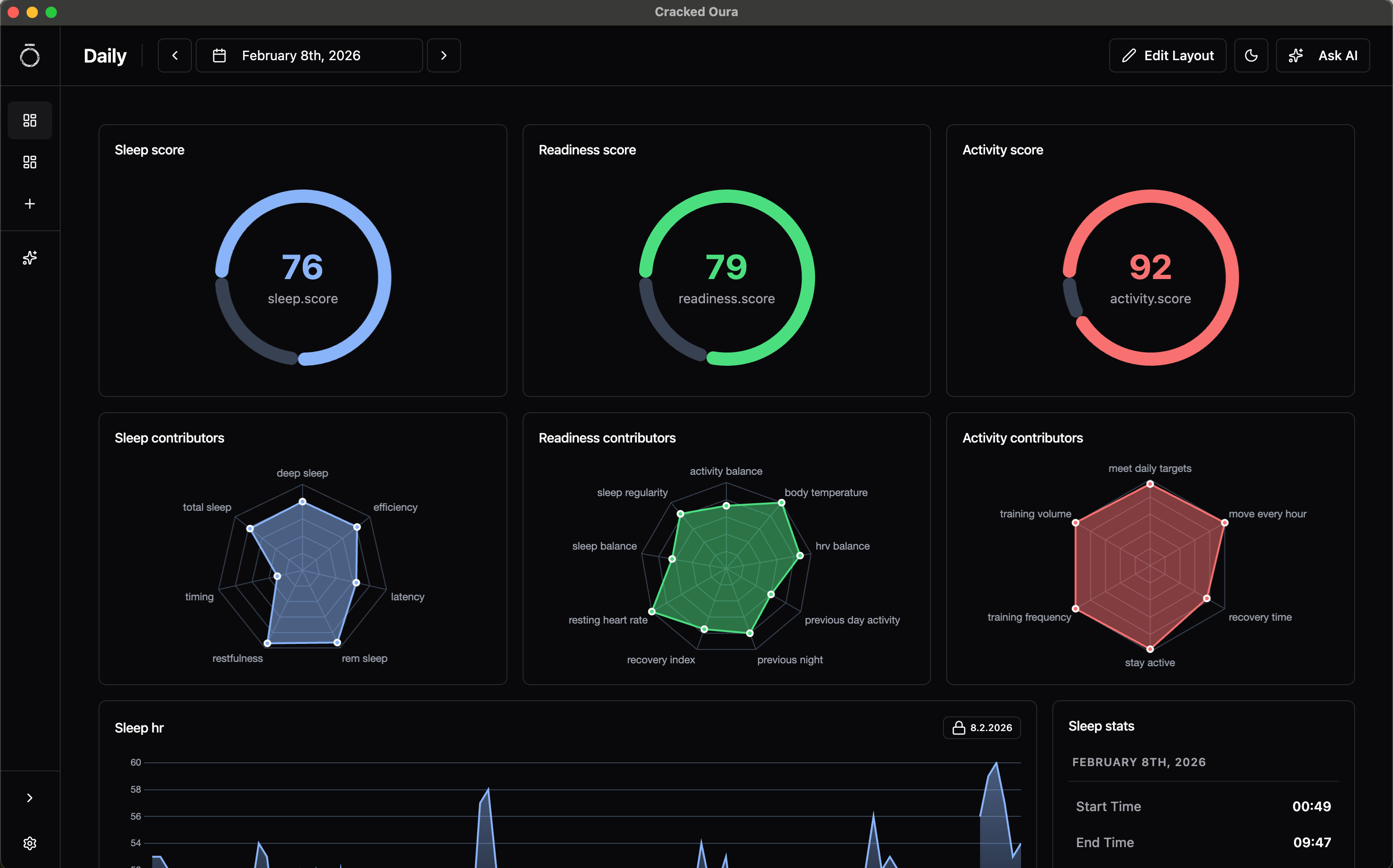
An Oura Ring will cost you $400 for the hardware, plus up to $70 a year to actually see your health data. Developer Elmo Ahorinta thought that was a bit rich, so he built Cracked Oura — an open source desktop app that pulls your sleep, readiness, and activity data out of Oura's ecosystem entirely and stores it locally in an SQLite database.
It then generates dashboards he says are "at least as good as the official Oura dashboard."
EU data portability rules require Oura to let users export their own data, so Cracked Oura simply automates that process and does the rest itself. No subscription required.
Read more: Android Authority | GitHub