
Ex-GitHub CEO returns with agent-first tools for developers
Plus: The EU trials Matrix for sovereign communications & more

Hi folks,
This week’s lead story looks at Entire, the new startup from former GitHub CEO Thomas Dohmke, which is betting that AI agents have outgrown the software development infrastructure built for human collaboration — and that openness should sit at the heart of whatever comes next.
Elsewhere, we track a fresh wave of open source developments: the European Commission trials a Matrix-based communications platform, Microsoft open-sources a sandboxing project called LiteBox, Snorkel backs new open benchmarks for agentic AI, and more.
As usual, feel free to reach out to me with any questions, tips, corrections, or suggestions: forkable[at]pm.me.
Paul
<Open issue>
An Entire rethink for the age of agents

Some six months after stepping down as GitHub CEO, Thomas Dohmke is back with a new open source-aligned startup, funded to the tune of $60 million in seed capital.
The gist is thus: AI agents are now generating huge volumes of code, but the tools developers use to manage that work were designed for humans, not machines. Dohmke’s new company wants to rebuild that layer.
Entire, as it’s called, is focused on building tools that help developers ship faster in an era increasingly shaped by automation. Its first release is an open source command-line interface (CLI) built around a feature it calls “Checkpoints.”
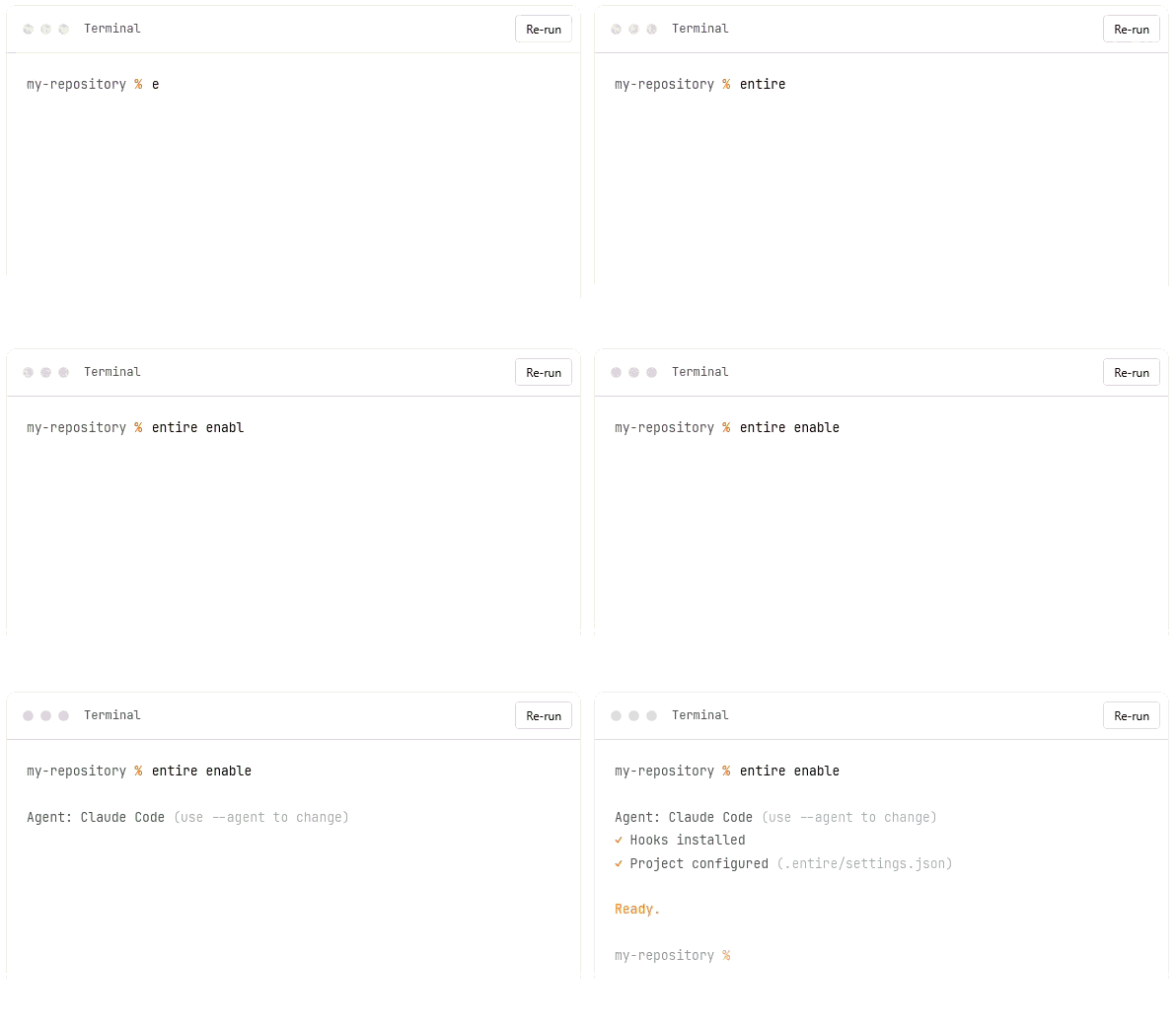
The idea is simple: when developers use AI agents to generate code, most of the reasoning behind those changes disappears once the session ends. Git records the final diff, but not the prompts, decisions, or iterations that led there.
The Entire CLI captures that missing context and stores it alongside each commit. Prompts, transcripts, files touched, token usage, and tool calls are saved as versioned data inside the repository — something that teams can review, trace, and revisit later.
More broadly, Dohmke describes a mission to rethink how software gets built in the age of AI, arguing that developers need infrastructure designed for autonomous systems rather than just autocomplete.
“Just like when automotive companies replaced the traditional craft-based production system with the moving assembly line, we must now reimagine the entire software development lifecycle for a world where machines are the primary producers of code,” Dohmke said. “Creating the assembly line for the era of agents.”
Read more: Entire (PR) & Entire (blog)
<Patch notes>
Europe enters the Matrix
After continued debate around Europe’s dependence on US tech providers, the European Commission (EC) is piloting an internal communications platform built on the Matrix open source messaging protocol. The trial reflects ongoing efforts to strengthen digital sovereignty by turning to infrastructure that can be hosted and governed within Europe.
Read more: Euractive
Let there be LiteBox
Microsoft has open-sourced LiteBox, a lightweight, sandboxed container environment designed to isolate applications on Linux by reducing their interface with the host system. LiteBox is still in active development, with Microsoft noting that the APIs and interfaces may change as the design matures, meaning that the project is pretty much experimental for now.
Sentry segues into Xcode automation
Application monitoring firm Sentry has acquired XcodeBuildMCP, an open source tool that “gives AI agents full control over [Apple’s] Xcode.” The move expands Sentry’s push further into developer tooling, with the acquired project set to remain open source.
Read more: Sentry
Vercel gets the bug bounty bug
Cloud platform Vercel has launched a dedicated bug bounty programme for its open source projects. Delivered via HackerOne, the initiative formalises vulnerability reporting and rewards for community contributors, as security scrutiny of widely used OSS components intensifies.
Read more: Vercel
Claude hunts software bugs
Anthropic says its Claude Opus 4.6 model is being used to identify vulnerabilities in software projects, including scanning open source repositories for bugs. The move adds to a growing trend of AI systems being positioned as automated reviewers of publicly available code.
Read more: Axios
Toyota teases Fluorite game engine
Toyota last week revealed that it’s developing a “console-grade” open source game engine dubbed Fluorite, built around the Flutter toolkit and the Dart programming language. It’s not clear when this will actually be released, but it’s being positioned for in-vehicle infotainment systems and similar digital dashboards, an area where automakers are increasingly relying on real-time graphics engines and Linux-based software stacks.
Read more: Phoronix
Snorkel backs open benchmarks to close agentic AI gap
Snorkel says current evaluation methods lag behind the pace of agentic AI development, leaving a gap between lab performance and real-world reliability. And that is why the AI startup is launching a $3 million Open Benchmarks Grants programme with partners including Hugging Face to support open, reusable evaluation tools.
Read more: Snorkel
Mitchell vs the machines
Open source veteran Mitchell Hashimoto this week introduced Vouch, an open source project aimed at adding verifiable identity and trust signals to open source projects. Arguing that AI tools have lowered the barrier to generating plausible but low-quality contributions, Hashimoto says the old implicit “trust and verify” model no longer holds. Vouch proposes an explicit system where trusted maintainers can vouch for contributors, restoring accountability in an era of machine-assisted pull requests.
<Final commit>
No receipt, no return…
Sometimes you see something so cool you just can’t help but do a small, involuntary “chef’s kiss". That was certainly the case when technologist Chris Hutchinson shared one of his latest side projects this week.
Hutchinson picked up a second-hand thermal receipt printer and wired it up to Claude Code so that every time he ends a coding session, a literal receipt prints out. Each slip shows a breakdown of the session’s spend by model, along with input and output token counts — a physical audit trail for AI-assisted development.
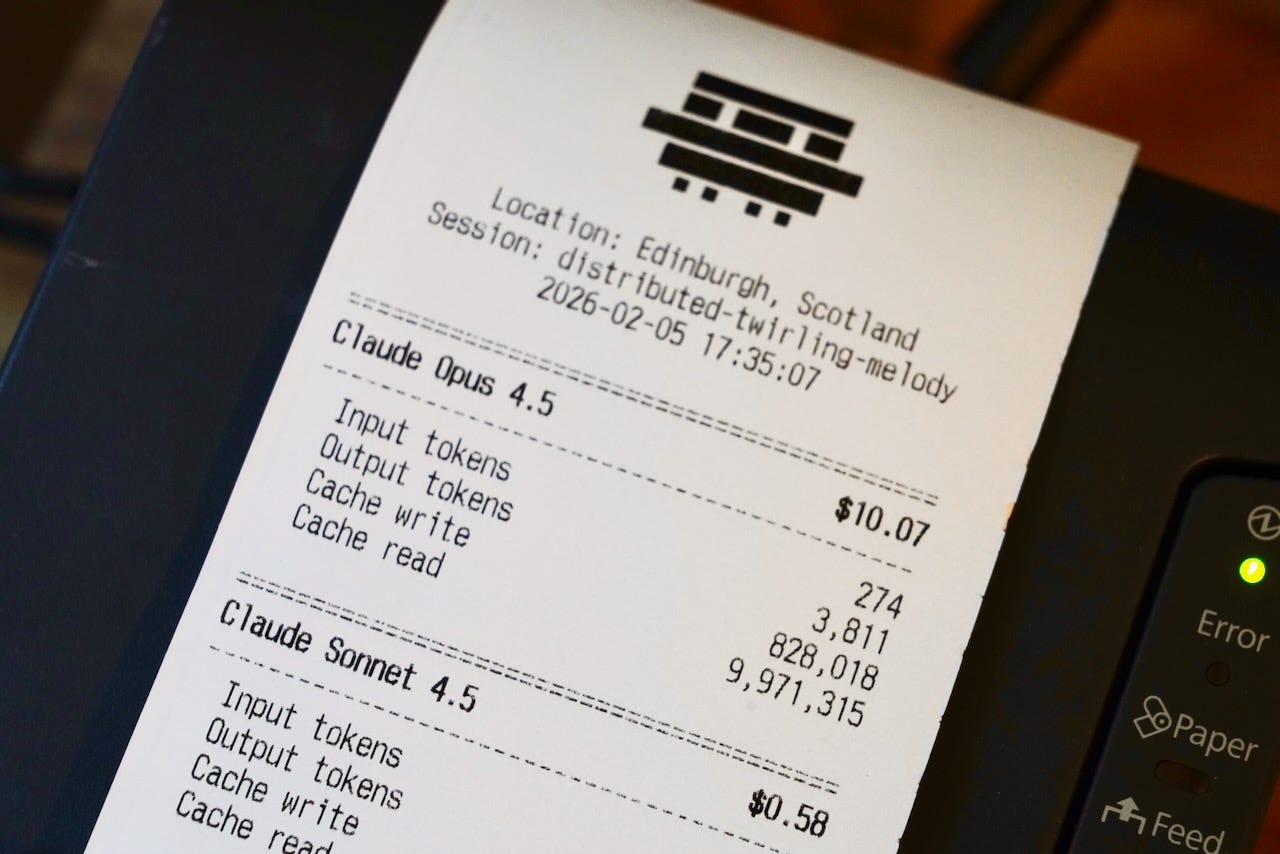
The receipts look like something you’d get from a late-night takeaway, except instead of kebabs they itemise Opus and Sonnet usage.
“It’s dumb, the receipts are beautiful, and I love it so much,” Hutchinson wrote, as he shared the project publicly on GitHub for anyone to use.
Hard evidence, if nothing else, that in the age of invisible token counts, some developers still want a paper trail.
Read more: Chris Hutchinson (LinkedIn) & GitHub