
GitHub pauses self-hosted runner fees after backlash
Plus: A fork in the road for Danish traffic authority, & more

Hi folks,
This week’s lead story digs into GitHub’s aborted attempt to start charging for self-hosted Actions runners, and the swift backlash that followed from developers.
Elsewhere, there’s a sobering update on how the Log4Shell fallout continues to linger, a Danish government agency making a clean break from Microsoft, and more.
As usual, feel free to reach out to me with any questions, tips, or suggestions: forkable[at]pm.me.
Paul
Open issue
GitHub’s runner rate rethink

Few things unsettle developers like being told they’ll have to pay for something that used to be free. That lesson landed squarely on GitHub this week, after the Microsoft-owned platform announced new fees for self-hosted GitHub Actions runners.
GitHub Actions, for the uninitiated, are the automation system built into GitHub that lets developers automatically run tasks (e.g. running tests or deploying updates) when code changes are made.
Runners, meanwhile, are the machines that execute those automated tasks. GitHub offers its own cloud-hosted runners, which are billed by the minute. But many teams opt for self-hosted runners, running the same workloads on their own servers or cloud infrastructure to control costs, improve performance, or meet security and compliance requirements.
With that in mind, GitHub announced that starting next March, it would begin charging $0.002 per minute for jobs executed on self-hosted runners. The change was presented alongside reductions in the cost of GitHub-hosted runners, part of what the company described as a move toward simpler pricing.
While the proposed change did not apply to public repositories — theoretically leaving open source projects untouched — in reality it would’ve had real consequences for research and open-science workflows that sit in a grey area between private and public development. For instance, academic labs and publicly funded research teams often rely on private repositories to develop software, analyze sensitive data, or prepare code tied to papers and dissertations before releasing it openly. For those teams, self-hosted runners are a necessity, allowing them to manage long-running, compute-heavy workloads within tight budgets.
One Reddit user, who said they work in a lab at a large U.S. research university funded by public health grants, made exactly this point, describing how they use GitHub Actions to build and ship a desktop app that helps researchers quickly run genetic analyses. The work needs to stay private for now, but the goal is to make it open source in the future.
The user pulled zero punches in their assessment.
“Microsoft loves to advertise when labs at research universities like us do cool research and use their products, but they don’t tell you that when they pull this kind of s**t it just ends up f*****g us,” they wrote. “I don’t know if we’re even able to migrate off GitHub, because it’s a lab with tons of private repos and members working on various projects. For now, GitHub is the one tool that most members can at least navigate.”
Over on LinkedIn, Duckbill chief cloud economist Corey Quinn summed up the reaction bluntly, questioning why developers should be billed when they are already paying for and maintaining their own infrastructure. “You bring your own hardware. You pay for your own compute. You maintain your own infrastructure,” Quinn wrote. “And GitHub wants to charge you… for the privilege of them not running your jobs? This is like your electric company billing you for the sunlight hitting your solar panels.”
GitHub, for its part, argued that this infrastructure is not free to operate. In a FAQ accompanying the announcement, the company said self-hosted runners had historically relied on GitHub Actions services that were effectively subsidized by hosted-runner pricing. The new fees, GitHub said, would better align costs with usage, emphasizing that the vast majority of customers would see no increase to their bills.
Within days, GitHub backtracked, announcing that it would postpone the self-hosted runner billing change to “re-evaluate” its approach, while proceeding with planned price cuts for GitHub-hosted runners.
For the open source community, the episode underscores a familiar tension. GitHub is both a commercial service and a foundational piece of open source infrastructure. Even when public repositories are spared, changes that reshape long-standing assumptions around cost and control can ripple through the ecosystem, testing trust in a platform many projects depend on daily.
Read more: GitHub & The Register
Patch notes
A fork in the road for Danish traffic authority
Denmark’s Road Traffic Authority is ditching Microsoft as part of a growing push to reduce dependency on proprietary software and bolster its independence. The change reflects broader public sector interest in diversifying beyond the dominant vendor platforms, with the agency shifting toward open source alternatives.
Read more: DR (Danish) & It’s FOSS
Log4j vulnerability still widespread despite fixes
Some four years after the infamous Log4Shell security flaw first emerged, data provided by software supply-chain firm Sonatype shows that around 13% of Log4j downloads still contain the vulnerability even though safe versions have existed for years. This reflects a broader pattern where developers and organisations continue to pull in outdated open source components rather than updating to secure releases.
Read more: Sonatype
Nvidia buys SchedMD but keeps Slurm in the open
Nvidia has acquired SchedMD, the company behind Slurm, a leading open source workload management system used in high-performance computing and AI clusters. Nvidia says it will continue distributing Slurm as open source, while investing in its development.
Read more: Nvidia
Google launches A2UI for agent-driven interfaces
Google has open-sourced A2UI, a new project for building user interfaces around AI agents. The goal is to make it easier to design consistent, interactive ways for people to work with agent-based systems.
Read more: Google
And finally…
Open source weighs in with MacBook trackpad scales
This might not be “news” as such, but it was news to me — and it serves a neat reminder that there are surprising tricks hiding inside familiar hardware.
A few months back, a developer by the name of Krish Shah took to the social network formerly known as Twitter to show how a MacBook’s trackpad can double as a digital weighing scale. By tapping into low-level Force Touch pressure data, Shah demonstrated that you can measure the weight of small objects placed on the trackpad, so long as a finger remains in contact to “activate” the sensors.
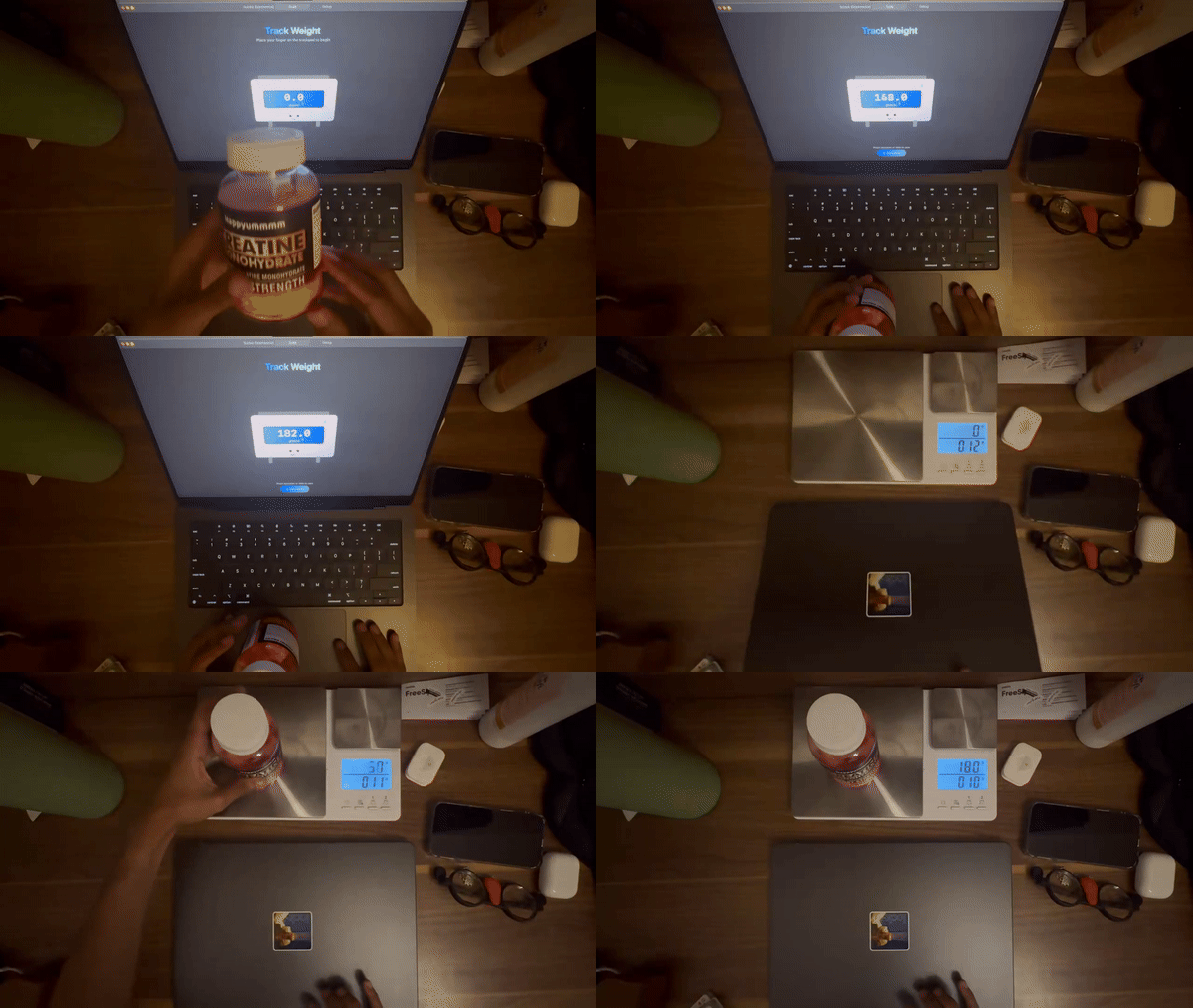
Shah later packaged the experiment up as an open source macOS app called TrackWeight, complete with calibration against a real digital scale and a list of limitations. It won’t be replacing your kitchen scales any time soon, but it’s accurate enough to be impressive.
It’s also a reminder of the creative lengths developers will go to when they’re willing to step outside Apple’s sandbox and poke at undocumented corners of the system. Not exactly a killer app — but a fun, subversive demo of what’s possible when curiosity outweighs convention.
Read more: Krish Shah [X] & GitHub